Learning Activities During the Race
These are some of the learning activities
we are engaging in during the Yukon Quest 1,000
mile sled dog race, from Whitehorse, Yukon to Fairbanks,
Alaska. The 2011 race begins on February 5th. It
will probably last between 9 and 14 days.
Literacy
- Daily read-a-louds from Hank
DeBruin and Tanya McCready-Debruin's book Iditarod
Dreamer (available in print and e-format via
the
Winterdance website)
- Yukon Quest Reading Challenge!:
Beat the Winterdance Race Team to Fairbanks, by
completing 1,000 minutes of reading before they can
complete the 1,000 mile trail.
(Post-race update: Students read for a combined
total of 35,941 minutes during the reading challenge!!!!
They have asked if they can compete in an Iditarod
challenge too! See "Post Race" section for more
details...)
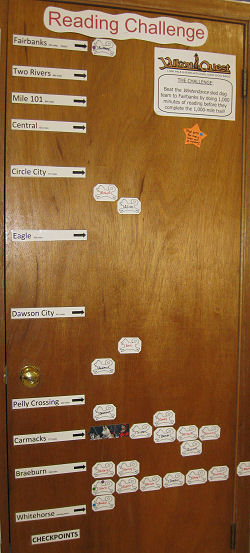 |
This is our Reading
Challenge Tracking Board.
The race
checkpoints are listed on the left,
and are
spaced appropriately according to
their
actual distances along the trail.
A
picture of Hank and the dogs is used to
indicate their position along the trail, in
miles.
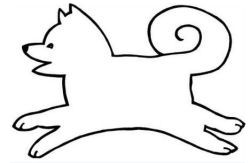
Each student has a picture of the
dog above,
with his or her name written on
it, to indicate
his or her position along the
trail, in minutes
of reading completed.
If a student reads for more than 1,000
minutes,
his/her dog is given "a ball"
(sticker) for each
1,000 minutes he/she has
read. Three of the
dogs in the picture
have obtained one or more
"balls" in this
way, and when the picture was
taken Hank was
only in Carmacks!
The board is updated daily throughout the
race. |

Students record their
daily reading
on this
template.
|
-
Trail Summary:
Choose a two checkpoints on the Yukon Quest
trail. Using the elevation graphic and trail description provided to
mushers on the Yukon Quest website and
information gleaned from the Yukon Quest
flyover simulation page, create a
point-form summary of the geographic features that
mushers can expect to encounter on that particular
section of trail. When the Winterdance Team
reaches the section of trail a particular student
summarized, we will post his or her summary in the hall
beside the map we are using to track the race.
(Grade 5)

This
interactive graphic on the Yukon Quest site
provides elevations and
information about
each checkpoint. |
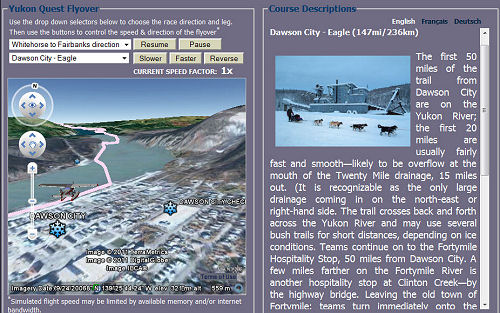
The Yukon Quest Google
Earth 3-D
Flyover Simulator provides a written
description and a view of the terrain between
the checkpoints on the trail.
There is
also a
written guide to the trail in the mushers`
section of the
Yukon Quest Official Website. |
- Dog Team Facts: Choose
one of the following topics:
--sled dog types
--positions in the sled dog team
--food and water on
the trail
--running and resting during a long race
--Yukon Quest checkpoint procedures
--dogs
that need to withdraw part way through the race
Research the topic using internet resources. Share your
jot notes with another student who researched the same
topic. Work together to develop at point form `Important facts` list. Lists will be posted on our
Yukon Quest display. (Grade 6)

Students researching
Yukon Quest checkpoint procedures |
 |
Yukon Quest Musher Math!
- Temperature Graphing Activity:
Using Environment Canada and US
Weather Service data, graph the high and low temperature
in Whitehorse, Dawson City and Fairbanks daily.
Calculate the temperature range for the past 24 hours at
these locations. (Grade 5)
- Temperature Graphing Activity:
Using Environment Canada and US
Weather Service data, graph the high and low temperature
AND windchill in Whitehorse, Dawson City and Fairbanks
daily. Calculate the temperature AND windchill
range for the past 24 hours at these locations. (Grade
6)
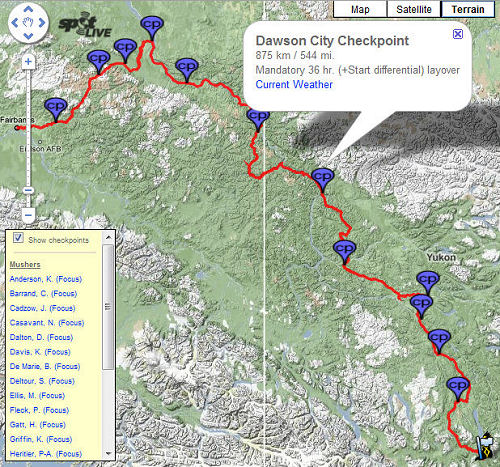
This
interactive topographic map on the Yukon
Quest site provides
links to temperature
data for the checkpoints (needed for this
activity)
and updates on the progress of
mushers (needed for the following activity). |

"Hank's Weather"
(weather at the checkpoint nearest his location)
is posted by the tracking map, daily. |
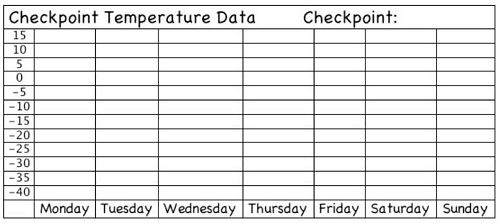 |

Blank
templates of the chart and graph are
available on the Yukon College
Quest Student
Website |

Student creating Hank's
high/low temperature tracking charts and graphs |

Charts and graphs for
comparing daily temperature
ranges where
Hank is with where we are |
- Track the Winterdance Team`s progress
daily, as they travel along the trail. Calculate
their total miles covered and the miles they have yet to
complete. (Grade 5)
- Track the Winterdance Team`s progress
daily, as they travel along the trail. Calculate
their total miles AND percentage of trail covered and
the miles AND percentage they have yet to complete.
(Grade 6)

This
distance chart on the Yukon Quest site
provides distances between
checkpoints in
both miles and kilometres. |

The
Current Standings Board on the Yukon Quest
site is updated regularly during
the race.
(NOTE: The example above does not reflect actual
race statistics.) |
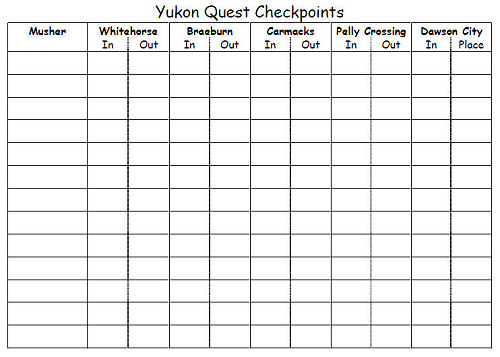
Students record the
statistics for each musher on this form.
A blank template is available on the Yukon
College Quest Student Website. |

Distance calculations
are added to our tracking map daily |
Science
-
Find out when sunrise and sunset
occurs, in Whitehorse, on the day the race begins.
Use this information to calculate hours and minutes of
daylight. Continue to collect sunrise and sunset
data for Whitehorse, throughout the race and calculate
how much the hours and minutes of daylight change each
day. Figure out why this change occurs.

Charts for comparing
hours of daylight in Dawson
City and where we
live, throughout the race |
Social Studies
- Plot the Winterdance Team`s progress
on our tracking map, daily.

Student looking up
Hank's location on the Yukon Quest
Live Tracking Map |

Student updating Hank's
location and travel statistics on our tracking
map.
A
blackline master of this tracking map is
available
on the Yukon College Quest Student
website.
|
- Research the history of dog sledding
in Canada: its importance to Aboriginal cultures and
importance to European settlers in the north.
Describe how the advent of roads and snowmobiles changed
the role of and need for dog sledding in Canada`s north.
(Grade 6: ties into their larger study of
Aboriginal culture in Canada)
Art
- Create an original piece of
northern-themed art, emulating the style of a favourite
Aboriginal artist.
|


