|
Projects |
||||||||||||||||||||||||||||||||||||||||||||||||||
           
For
more ideas visit
...and
our
Click
the graphic
Click
the graphic
|
Integrated
Study Unit, October 21, 2006 Dear
Parents: As
your son or daughter may have already mentioned, our class has just
begun an integrated unit following the “Ultralight-guided” migration
of eighteen juvenile Whooping Cranes from Wisconsin to Florida.
This is the sixth annual migration training mission to be
conducted by Operation
Migration,
a Canadian non-profit organization based out of Port Perry, Ontario.
The migration will probably be complete in early to mid-December. Our
study of this migration, and the endangered Whooping Crane in general,
will touch on several curriculum areas:
Language (reading, writing, oral communication and media
studies), Science (the Grade Two animal unit), Math (numeration,
graphing and estimation), Social Studies (mapping), Computer Studies (following
migration progress and conducting Whooping Crane research via the
internet), Character Education (citizenship, responsibility, caring) and
Art. In
November, we will be creating paper mache Whooping Crane sculptures.
You can help by saving up newspapers and paper rolls (from gift
wrap, paper towel and toilet paper) and sending them to class. Some
of our Whooping Crane-related classroom activities will soon be posted
on the internet. In the
meantime, you and your son or daughter might enjoy exploring the
following web sites together: Journey North— http://www.journeynorth.org Operation
Migration—
http://www.operationmigration.org Sincerely, Margaret Black
Migration
Math:
Each day the birds fly, we obtain their flight distance from the Operation Migration web page. Then: 1. We add today's flight distance to the distance flown on previous days (in kilometres). This tell us the total distance the birds have flown to date.
2. We subtract the distance flown to date from the total distance in the journey (in kilometres). This tells us how far the birds still need to fly, to reach their winter home.
3. We update the kilometres flown and kilometres left, on our "scoreboard."
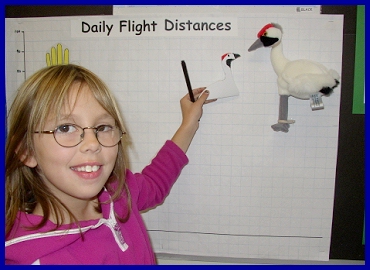
4. We update our bar graph, that depicts daily flight distances, and discuss what kind of day the birds had, compared to previous flight days.
5. When the birds reached the half-way point in their journey south (Cumberland County, Tennessee), we estimated the date they would arrive at their winter home. Throughout the remainder of the migration, we will use the data we have collected (i.e. our tracking map, daily flight distance graph, "no-fly" day tally and "scoreboard") to make revisions to our estimates. These are our initial predictions, made on November 22nd:
Here is a bar graph, depicting our initial predictions:
6. After a woman donated a mile of travel expenses to Operation Migration, in honour of our class, students asked if they could donate money to the cranes. Throughout the month of November, we kept a "Crane Cash Jar" at school and students brought in loose change from home, from time-to-time, and placed it in the jar. On November 30th, students engaged in a real-life numeration activity. They sorted, stacked, rolled and counted all the money in the jar. Then, we sent a cheque to Operation Migration, to assist them in getting the cranes to Florida. Here's how this activity went:
NOTE: This real-life math lesson was also featured on the Journey North educational web page! Whooping
Crane
In our classroom, we have many fiction and non-fiction resources about Whooping Cranes and Ultralight-guided migration. The students enjoy perusing these books and information sheets during silent reading periods, or when their work is complete and they have a few minutes to spare.
Computer
Lab. Explorations
Once each week, our class has an opportunity to spend a period in the school's main computer lab, where there is a computer for each student. Throughout the migration, we are spending at least part of our computer time exploring Whooping Crane-related websites together. As part of our Grade 3 Social Studies unit, we are also using the internet to explore the urban environments where our "migration pen pals" live: Houston, Texas; Louisville, Kentucky; and Tampa, Florida. This picture shows several students browsing the Journey North site for Whooping Crane information and migration news:
Journey
North Information Booklet
Each week, we read one of Journey North's booklets about Whooping Cranes and Ultralight-guided migration. Afterwards, students answer a "reflection question" about the day's reading. At the end of the day, each student is given a copy of the booklet to take home and share with his/her family.
"Persuasive"
Letter-writing
Because
it is with the children of today that lies the hope for all the world's
creatures and their habitats, we at Operation Migration are never more
pleased than when our efforts, and our work on behalf of the endangered
Whooping crane, inspires them.
I
am going to have my 'Canadian Craniacs' write letters to Exxon, in
Texas. We will let the CEO know that American school kids along
the flight path aren't the only ones cheering the Whoopers on, during
their migration, and that we too would like to see Exxon lend a helping
hand, via a financial and/or fuel-related contribution to the project.
This is my class holding up their finished letters:
This is my cover letter to Mr.Tillerson: Margaret
A. Black October
23, 2006 Mr.
Rex W. Tillerson, CEO Dear
Mr. Tillerson: Last
month, a class of students from Kentucky wrote to you, asking your
company to assist with an amazing project.
That project is Operation Migration’s Fall 2006 Ultralight-guided
Whooping Crane migration from Wisconsin to Florida. My class is writing to you, today, to tell you that American
children, on the flight path, aren’t the only ones interested in this
venture. Canadians, are
also cheering the eighteen juvenile Whooping Cranes and their amazing
pilots and handlers along, as they journey southward together. I
remember, well, the desperate measures conservationists employed, during
my childhood and teen years, to keep Whooping Cranes from
becoming extinct. In 1941, there were only 15 Whoopers left. In
1960, the year I was born, there were 33. I was seven years old
when American and Canadian biologists came together to redouble their
efforts to save the Whooping Crane.
At that point, there were still only about 50 birds left. I
recall the celebration when, in my early twenties, biologists announced
that Whooping Crane numbers had finally surpassed the 100-mark.
And, on September 6th, 2006, biologists announced that there
are now 500 Whooping Cranes in existence! The
only remaining natural, migratory flock of Whooping Cranes travels
between Wood Buffalo National Park, in northern Canada, and The Aransas
National Wildlife Refuge, in Texas. Operation Migration is reintroducing a migratory flock of
Whooping Cranes to eastern North America.
Their reason for doing so is to safeguard the species. If
an oil spill, storm or other such disaster was to hit the western flock,
and there wasn’t another population of wild birds living in elsewhere
on the continent, the entire wild
population of Whooping Cranes
could be wiped off the face of the
planet in a single incident. I
told my students I have a dream that, when they are adults, they will
tell their children the story about how the Whooping Crane USED TO BE an
endangered species, and about the remarkable efforts that incredibly
creative, talented and dedicated people made to bring the species back
from the very brink of extinction.
I am doing what I can to make this dream a reality.
I am encouraging my students speak out about issues that matter
to them, such as the plight of the Whooping Crane, and I am personally sponsoring
one mile of Operation Migration’s travel expenses, during the current
migration, for $206. USD. Operation
Migration is a non-profit, charitable organization that relies upon the
generosity of corporations and individuals to carry out its work. At present, only half of the required funding is in place for
the 2006 migration from Wisconsin to Florida (currently underway).
With four Ultralight aircraft, a Cesna and several ground support
vehicles, as their means of transportation, one of Operation
Migration’s greatest expenses is for fuel.
I challenge your company to join me in supporting Operation
Migration with a generous gift of fuel or funding. My
students and I thank you for your time.
Sincerely, Margaret
A. Black
These are some of the letters my class wrote:
Kids CAN make a difference! On December 22nd, the following letter arrived at Harriett Todd P.S.:
(Storybook format:
Media
Literacy Study:
In order to satisfy part of our new media studies curriculum requirement, our class is studying the differences between the true story of how, in 1992, Bill Lishman and Joe Duff came to fly a flock of eighteen Canada Geese from Ontario to Virginia, behind Ultralight Aircraft, and the Hollywood version of this story. Our comparison will focus on the characters and events presented in the book "Father Goose and his Goslings" and the movie "Fly Away Home," with specific reference to why students think the producers felt the need to change certain elements of the story when they made the movie.
"Crane Art" Lesson
One weekend, a Grade Three student in my class, who is very excited about our migration study, made several Whooping Crane crafts at home. On Monday, she brought in two of her creations to show us. I invited her to teach the class how to make her pop-up crane design. Everyone enjoyed the student-led art lesson and got to take home a really nice, little Whooping Crane ornament. Thanks Amy... you did a super job! (P.S. Stay tuned for further student-led art lessons. Amy is now spending her spare time, at home, working on craft-prototypes of an Ultralight Aircraft!) NOTE: This project was also featured on the Journey North educational web page!
Our class is constructing eighteen, 2 1/2 foot tall, paper mache Whooping Cranes, one to represent each member of the real flock. This project meets several Grade Two and Grade Three Visual Arts curriculum expectations and also touches on the Grade Three Science topic, Structures and Mechanisms: Stability. NOTE: This project was also featured on the Journey North educational web page!
|